What do you actually do for a week in a room where you can’t see your own hand? We hear this question before nearly every first dark retreat. The honest answer: much less than you think, and more than you expect.
Lenka and I have accompanied more than 3,000 people through stays in the dark since 2013, and I spent a week alone in the dark myself. So this page isn’t theory. It’s what a dark retreat looks like in our cabins near Kutná Hora, from the evening you arrive to the moment you open the door again.
A dark retreat is mostly about what’s missing
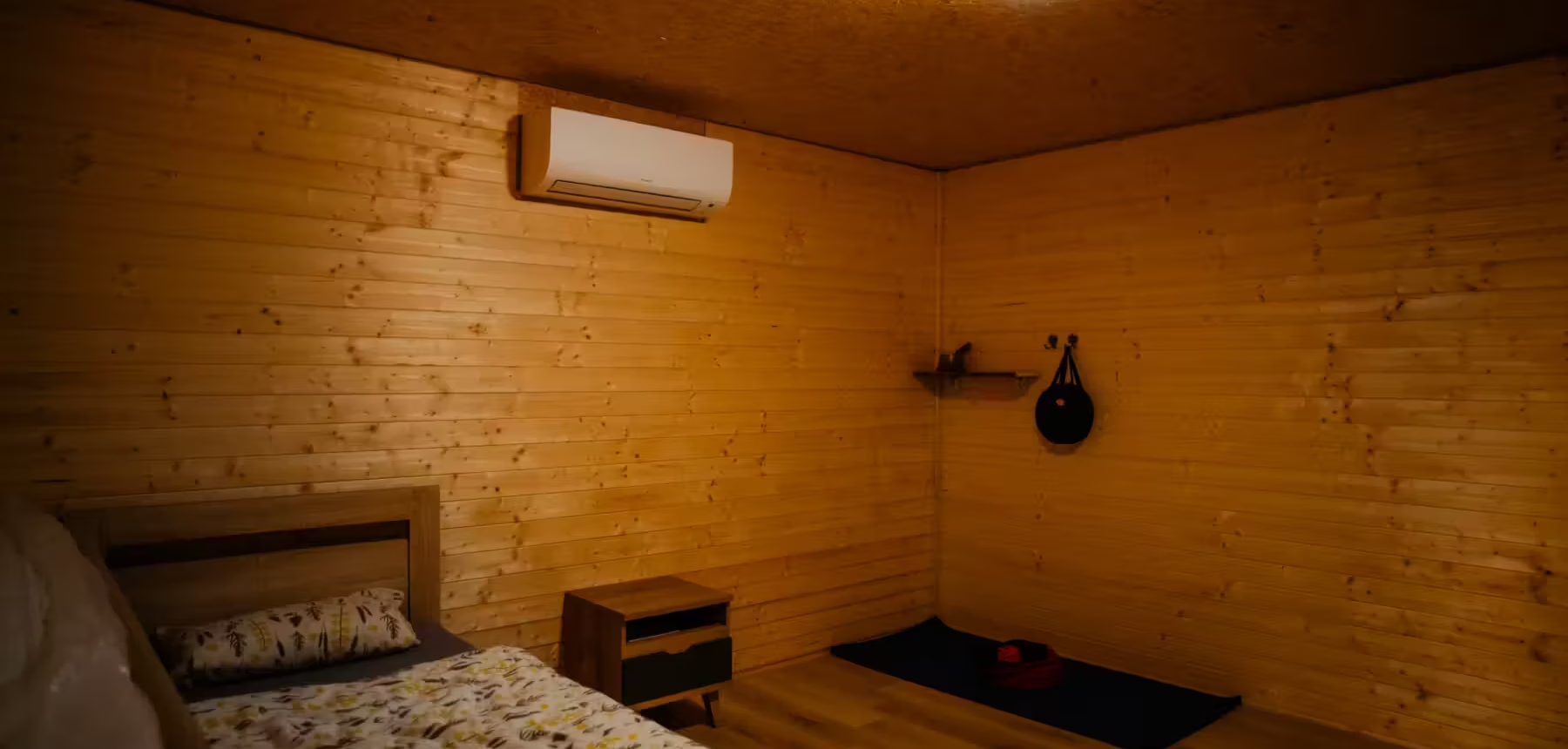
No light. No screen. No programme, no group, no teacher telling you how to breathe. You spend the whole time alone (or as a couple) in a small cabin that is completely dark – not “dim”, not “cosy”, but dark in a way most people have never experienced. The food comes to your door, the shower is warm, the bed is comfortable. Everything else you bring along in your own head.
It isn’t a test of endurance and nobody is grading you. You can sleep for three days, sit, stretch, think, cry, laugh or do nothing at all. Can you, must you? You can, and you don’t have to. That’s the whole freedom of it.
Day by day: how a stay in the dark goes
Arrival: towards evening, with the light still on
A week starts on Saturday (exceptionally Wednesday), three nights on Wednesday or Saturday, a single night on Tuesday. You arrive towards evening – by car, or we pick you up from the station. While it’s still light, we walk you through the cabin: where the shower is, where the ventilation switch is, where the kettle stands, where the food will appear. You switch off your phone or put it away. Then we leave you, and you switch off the light yourself. Nobody does it for you.
The first night and the first days: mostly sleep
This surprises almost everyone. People tell us the first days are mostly sleep – long, deep, sometimes at strange hours. They say they’ve finally had a proper night’s rest after months. The body seems to collect what it’s been owed. Don’t fight it; there’s nothing you’re supposed to be doing instead.
Food through the anteroom
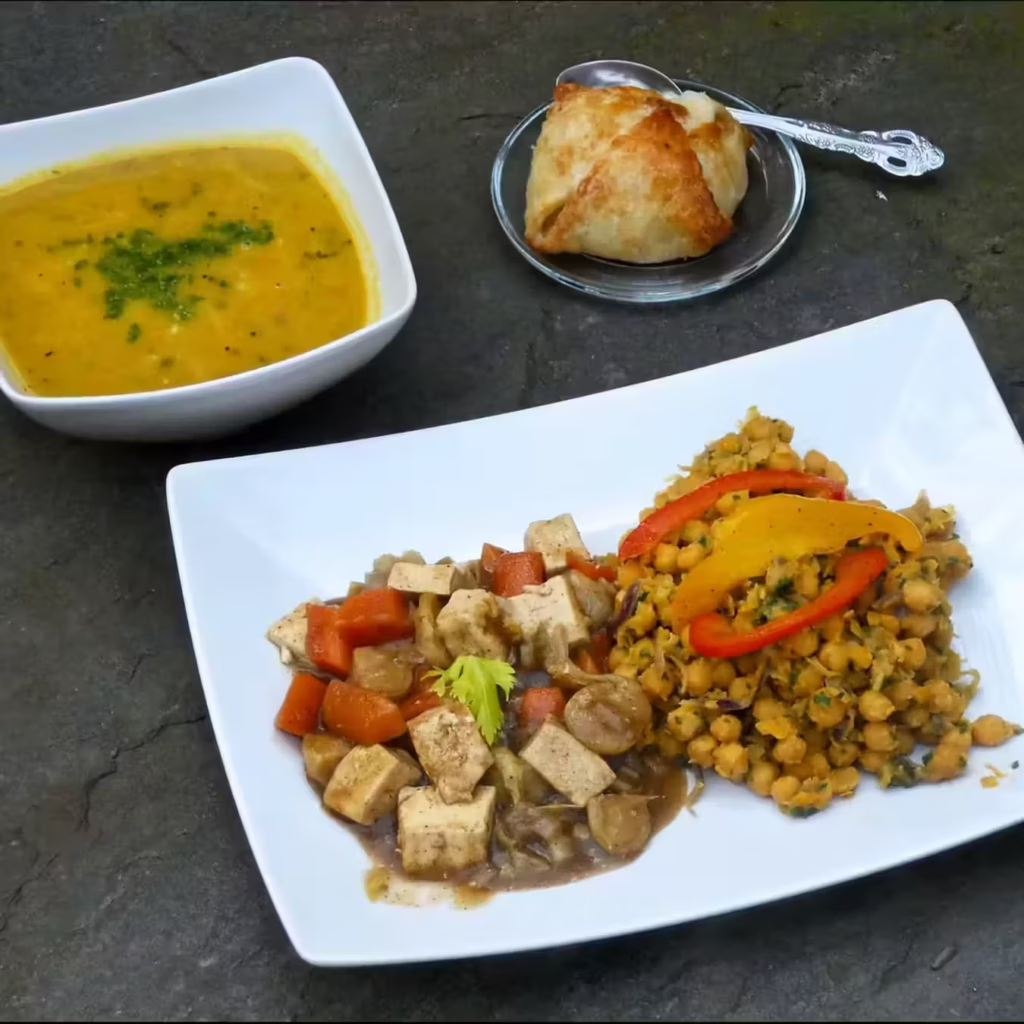
Each cabin has a small anteroom with a shelf for food and a thermos. That’s where we bring vegetarian meals for the whole day, and it’s arranged so that food can be handed over without a single ray of light getting in. You find the plates by touch, which quickly becomes normal. If you prefer, you can bring your own food or fast; there’s a kettle in every cabin. And yes, spaghetti in total darkness is a skill. You’ll learn it 🙂
The middle: time melts, the mind protests
After a few days you stop knowing what time it is, and then you stop caring. People say time simply melts. This is often also the moment when the mind throws a tantrum. It tells you this is pointless, that you could be doing something useful, and it asks, quite loudly: “What am I even doing here?” That voice is normal. Almost everyone meets it. You can listen to it the way you’d listen to the radio in another room – and carry on lying there.
If you want to stop
You can end your stay at any time. Nobody locks you in: the light switch is yours and the door opens from the inside. If you need us, you can let us know when we bring food, and we live in the log house fifty metres away. About one in ten people leaves early. That number isn’t a failure rate, it’s just people listening to themselves – which is exactly what you came for.
Back to the light
At the end of your stay you open the door to daylight again. Take it slowly. People tell us light is very sharp at first, colours are brighter, and food and smells are suddenly intense – an apple can be quite an event. Give yourself a quiet first few hours before trains and cities. There’s more about that in our article on coming back to the light.
What people experience in the dark
Everyone’s stay is different, but some things come up again and again in what people tell us:
- Sleep – many sleep more than they have in years, and wake up without an alarm for the first time in ages.
- Colours and images – in total darkness, many people see colours, shapes or pictures in front of their eyes. Not a rule, but it happens, and it’s nothing to be afraid of.
- Strong emotions – old memories or feelings can surface. It isn’t always pleasant, but it’s honest, and it usually passes on its own.
- Quiet – after the noise in the head settles down, many describe a calm they didn’t know they could reach.
A participant – let’s call him Jonas – arrived for three nights with a long list of things he wanted to “sort out in the dark”. On the last morning he admitted he’d slept through most of the list. “It was easier than I imagined,” he said, “and too short.” We hear both sentences a lot. Roughly 80 % of people who come for three nights say afterwards it wasn’t enough, which is one reason most people choose a week.
What we don’t do is promise results. We’re not a clinic, and a dark retreat isn’t a medical procedure. What we see is simpler: people leave slower, quieter and often surprised – not because something was done to them, but because for once they gave themselves time.
Where the practice comes from
Retreating into darkness is old. In Tibet it has long been a meditation practice, known as yangti in the Bön tradition and in Dzogchen. In Germany, Holger Kalweit brought the idea to a Western audience under the name Dunkeltherapie. In the Czech Republic it’s known as terapie tmou or simply a stay in the dark, and it has become so common that of the roughly 45 centres we know of in Central Europe, more than half are here.
Our own approach is down to earth. We don’t teach a tradition and we don’t prescribe any technique. You can meditate if you want to, but you don’t have to. Stays near Kutná Hora are also part of a long-term study by the Department of Psychology at the University of Ostrava, together with its Faculty of Medicine, looking at things like cognitive functions, blood pressure, heart rate variability and melatonin. We mention it because it’s true, not because we’d draw any promises from it.
Is a dark retreat right for you?
For most people, yes – but not for everyone. Please come sober, tell us honestly about your health, and if you’re unsure, start with a shorter stay. If you have a history of serious mental health difficulties, epilepsy or a condition that needs supervision, read our safety page before you book and talk to your doctor. When in doubt, write or call us first; we’d much rather talk beforehand than have you surprised in the dark.
Fear of the dark, worry about getting bored, the thought “I’ll never last a week” – those aren’t reasons to stay home. They’re what nearly everyone brings along on the first evening. Bring them too, and see what’s left of them after a few days.
See you in the dark – Tom & Lenka
P.S. Worried you’ll get bored? Ask yourself again on day five 🙂