At half past four in the afternoon the fields around Lomec are already turning blue, the orchard is white and the village of thirty people has gone quiet. A dark retreat in winter can sound like a slightly odd plan – darkness inside, darkness outside, snow on the road from Prague. Lenka and I actually like the cold months a lot. We’ve been running dark retreats near Kutná Hora since 2013, in every season, so here’s an honest look at what winter changes and what it doesn’t.
First question: isn’t a wooden cabin cold in January?
No. It’s a fair question, though, because from the outside our cabins look like garden sheds that grew up 🙂 Inside it’s a different story. The walls have 20 cm of insulation, the ceiling 30 cm, the floor is solid spruce, and each cabin stands about 10 cm above the ground on screw foundations, so the cold from the frozen soil stays where it belongs.
The heating is a heat pump with underfloor heating, which means the warmth comes from below and you can walk around barefoot in January. There’s also a small 0.5 kW backup heater, chosen specifically because it doesn’t spark. Making sure that neither the heat pump nor the heater gives off even the faintest glow took some effort – a heating system with a friendly green standby light would be a funny thing to have in a dark room.
Fresh air comes in through ventilation with heat recovery: the warm air going out warms the cold air coming in, so you breathe outside air without letting the winter in. The switch is by the door and has two speeds. The indoor unit runs at about 22 dB, roughly the sound of leaves rustling.
Why winter and a dark retreat get along so well
In summer there can be a small voice in your head saying: the sun is shining and I’m sitting in the dark. In winter that voice is much quieter. The garden is asleep, the days are short anyway, and going inside for a week feels less like missing something and more like following the season.
What happens in the dark itself doesn’t depend on the calendar. People tell us the same things in January as in June: the first days they mostly sleep, time melts, and somewhere along the way the mind throws a little tantrum – “what am I even doing here?” – before it settles. Winter just puts a cosy frame around it all: snow outside the walls, a warm floor inside, a thermos of tea on the shelf.
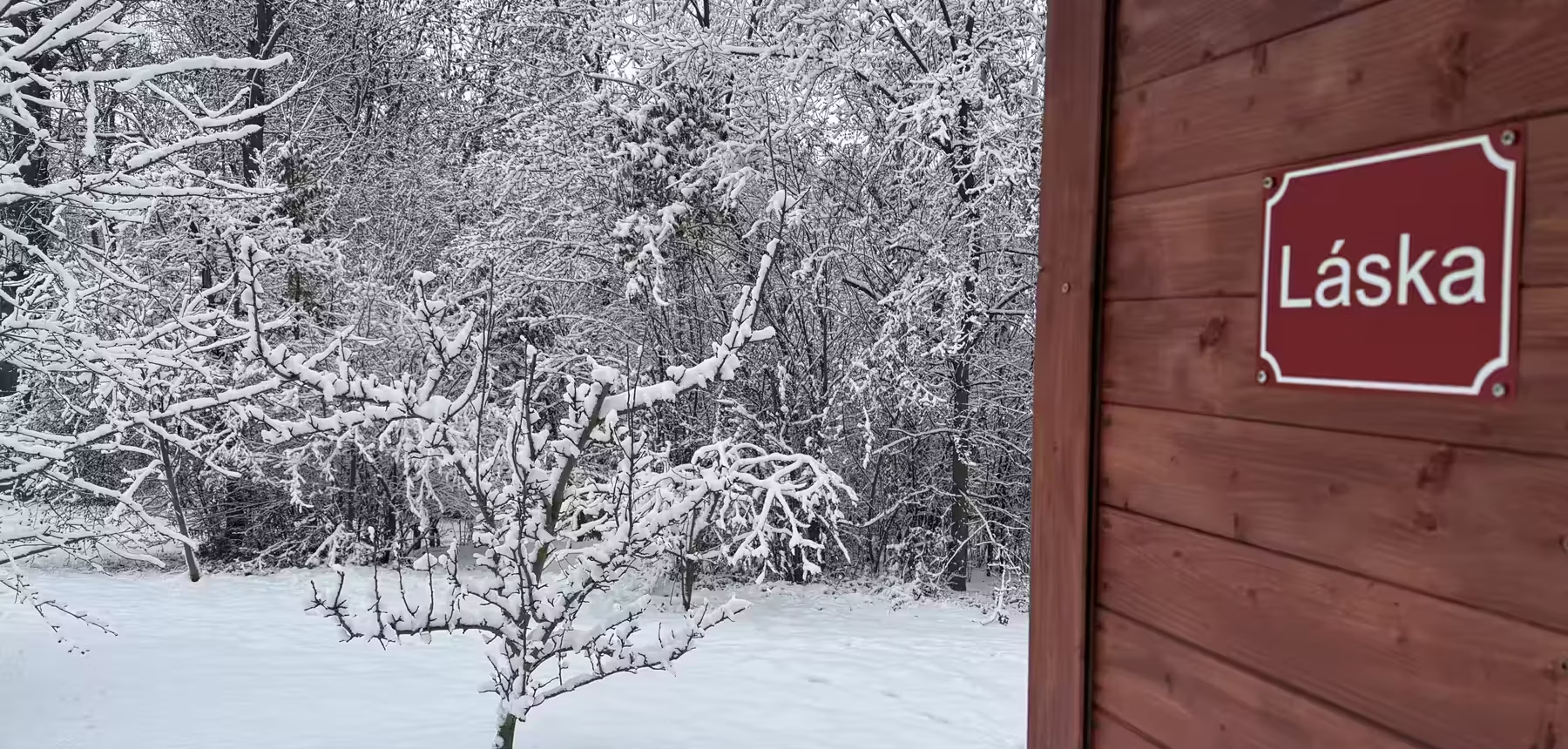
A participant from Leipzig, let’s call her Marie, chose a week in February because, as she put it, “there’s nothing to miss outside anyway.” When she came out, the orchard was covered in fresh snow. She stood in the doorway for a long while and then said the sentence we hear surprisingly often: “It was easier than I imagined.”
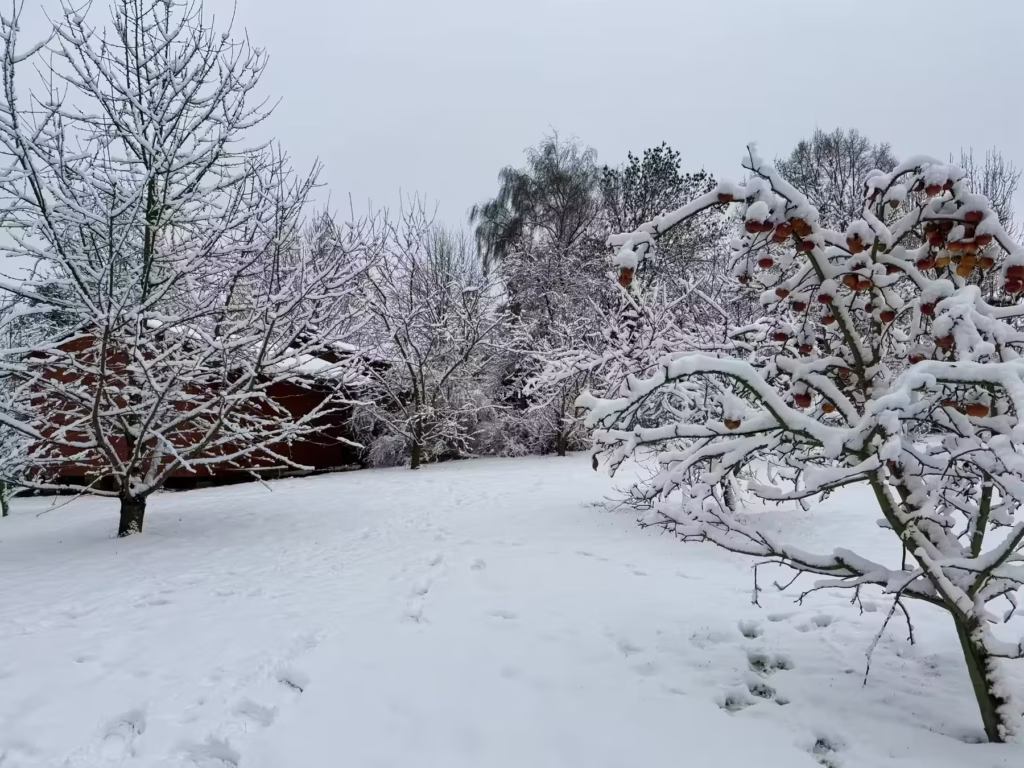
Coming out into a white world
After days in the dark, light feels sharp – that’s what people tell us in every season. Snow adds to it, because it throws the light back at you from everywhere at once. So in winter, keep sunglasses in your bag, open the door slowly and give your eyes a few minutes before you look across the bright field behind the garden.
The other senses wake up too. The cold air suddenly smells of something – wood, snow, the fields – and the first warm drink after the dark tastes stronger than you remember it. If you want to know more about those first hours, we wrote about them in Coming back to the light.
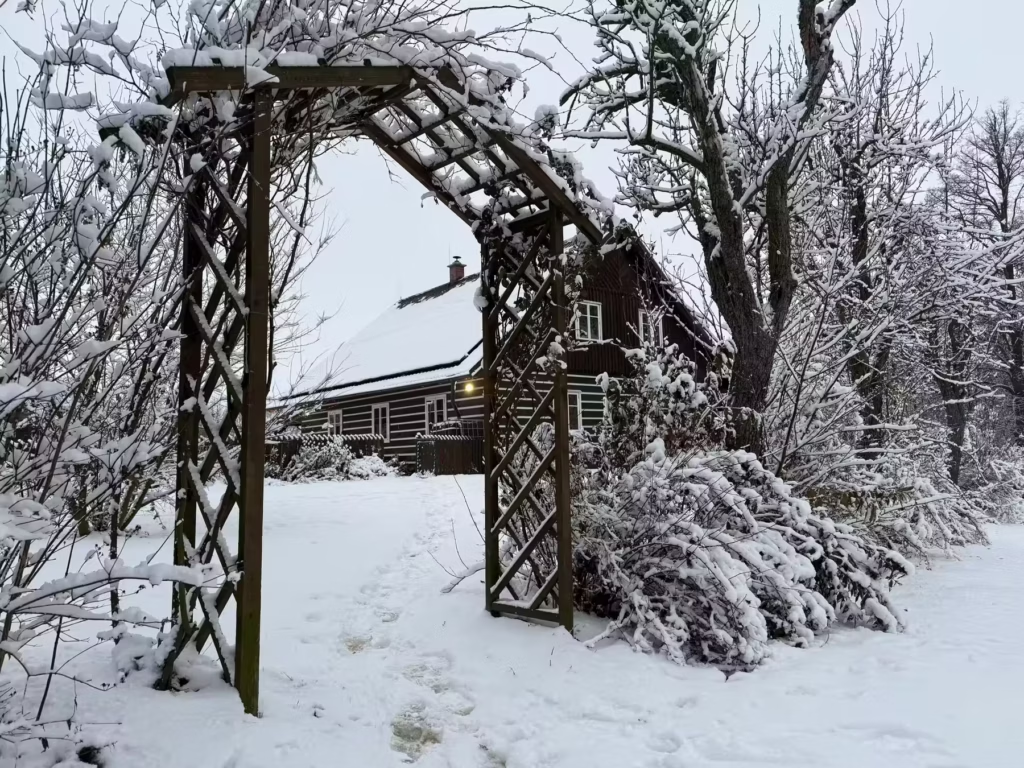
Kutná Hora in winter, before or after the dark
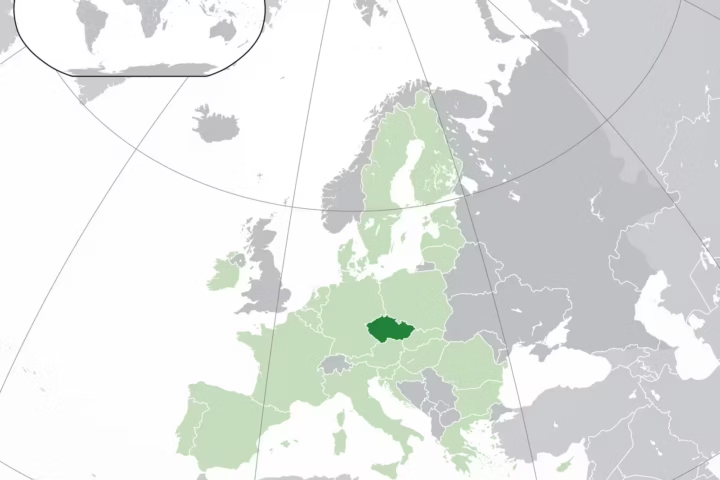
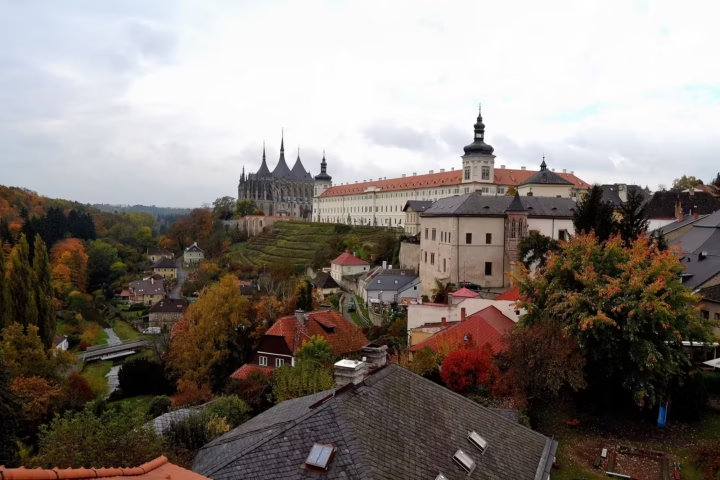
Kutná Hora is about 20 minutes by car from us, and in winter it’s a lovely place to land before or after your dark retreat. The historic centre with the Church of St Barbara, together with the Cathedral of the Assumption in Sedlec, has been on the UNESCO list since 1995. Walk along Barborská street with its row of statues above the valley, look at the Jesuit College – today the GASK gallery – with snow on its roofs, and if you’re in the mood, visit the Sedlec Ossuary, the chapel decorated with human bones.
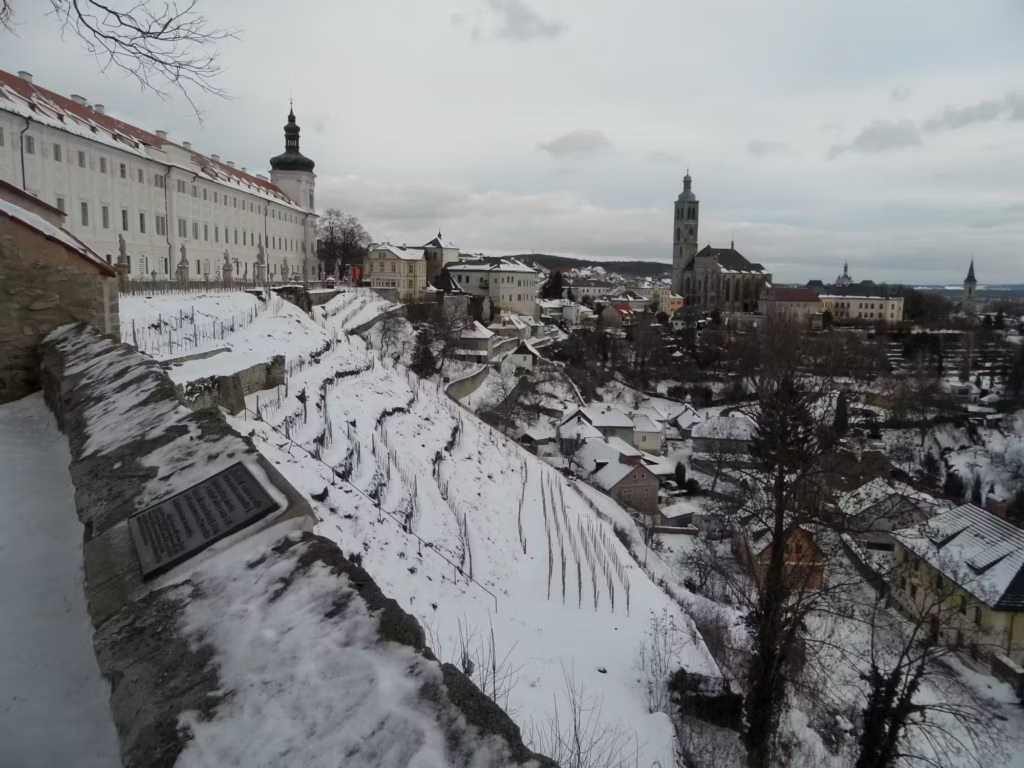
More ideas, including the old royal mint at the Italian Court and the silver mine, are in our Kutná Hora travel guide.
Getting to a dark retreat near Prague in winter
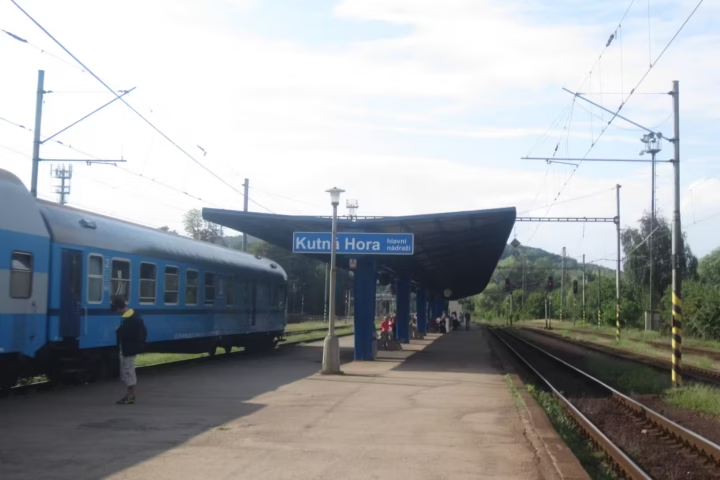
The train is the easy choice. From Prague main station to Kutná Hora it takes about an hour, with direct trains roughly every hour during the day – check the current timetable on cd.cz. We’ll pick you up for free at Kutná Hora, Čáslav or Bykáň station. The 6 km walk from Bykáň via Úmonín, past the château, through a little pine wood and along a field path, is lovely on a summer afternoon. On a January evening, when it’s already dark by the time the train arrives, let us drive you.
By car it’s about an hour and a quarter from Prague: the D11 towards Hradec Králové, exit at Kolín, then on to Kutná Hora and Lomec. Plan for winter roads and a little extra time on the last country kilometres. Parking at our place is free.
What to pack for a winter week
Warm clothes for the journey, of course. For the cabin itself you need less than you’d think: comfortable layers, warm socks and slippers. Everything else is in our dark retreat packing list.
And the other seasons?
We run dark retreats all year round. The darkness in the cabin is the same in every month; what changes is the world you step back into.
- Spring: the orchard wakes up, and your first steps out of the dark smell of wet grass and blossom.
- Summer: the heat pump cools as well as heats, so the cabin stays pleasant even on hot days. Coming out on a long summer evening is a soft way back into the light.
- Autumn: apples in the orchard, morning mist over the fields and Kutná Hora in full colour – a good time to add a few days of sightseeing.
- Winter: snow, short days, warm floors. In other words, everything you’ve just read 🙂
So which season should you choose?
Honestly? The one in which you can really switch off. About 80 % of people come for a week, and a free week is easier to find in some months than in others. If you have the choice, and you like the idea of snow outside the door and a warm floor under your feet, winter is a very good bet. Here are the next free dates:
- Cabin of Friendship is available from 28 Oct 2026 −15 % · Last minute: arrival within 7 daysBook 3 nights ·
289246 - Cabin of Freedom is available from 31 Oct 2026 −15 % · Last minute: arrival within 7 daysBook 7 nights ·
595506Book 3 nights ·289246 - Cabin of Friendship is available from 4 Nov 2026Book 3 nights
- Cabin of Love is available from 7 Nov 2026Book 7 nightsBook 3 nights
- Cabin of Peace is available from 11 Nov 2026Book 3 nights
See you in the dark – Tom & Lenka
P.S. In the dark, January and July feel exactly the same. You only find out which one it is when you open the door.